
Radar data types
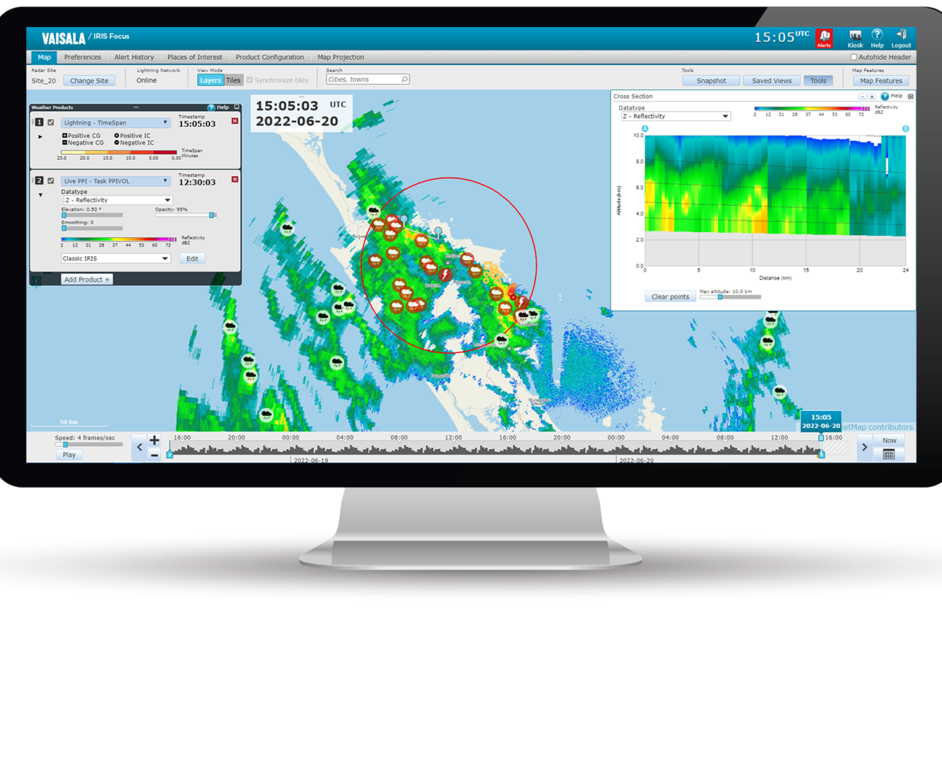
Radar product data types define what is calculated from the received radar pulse reflections.
The data types are used in both IRIS Analysis and on-demand products.
- In IRIS Analysis products, the data type is indicated in the radar product name.
- In on-demand products, you can select the intended data type from the drop-down menu on the Weather Products pane.
Data types in IRIS Focus never use letters from the Greek alphabet, and are always written in uppercase, even when signal processing and meteorological conventions use subscript. For example, instead of Φh, IRIS Focus uses PHIH.
Horizontally and vertically polarized pulses
are generally abbreviated in the data types as H and V.
Data types that use both polarized pulses as input include a combination of letters
H and V to describe the pulse types used. For example,
HV refers to both horizontal and vertical pulses being transmitted and
received.
| Data type | Definition | Description |
|---|---|---|
HCLASS |
Hydrometeor Classification | Estimated hydrometeor type in the precipitation area. |
KDP |
Specific Differential Phase | An indicator of the rate of change of the phase difference between horizontally and vertically polarized pulses of the radar. A greater horizontal shift results in a positive KDP value, and a greater vertical shift results in a negative KDP value. Typical cause for a high KDP area is heavy rain. |
LDRH (LDRV) |
Linear Depolarization Ratio H to V
(or V to H). |
The ratio of cross-polar to co-polar reflectivity measured in dB. |
PHIH (PHIV) |
Horizontal (or Vertical) Differential Phase |
Phase difference for the total round trip between radar and the volume where the signal is reflected.
|
PHIDP |
Differential Phase | The phase difference due to propagation between the
HH and VV channels of the radar. |
RHOHV (RHOH/RHOH) |
Correlation coefficient between HH and
VV (or HH and HV /
VV and VH) channels ) |
Higher (>0.95) values indicate uniform precipitation areas and lower values more mixed hydrometeor types, such as melting snow, wet snowflakes, or airborne debris. |
SNR |
Signal to Noise Ratio | Generic measurement of signal-noise ratio in dB. |
SQI |
Signal Quality Index | A value between 0 ... 1 that measures the signal's Doppler
coherency, that is the correlation between the signal and its Doppler lag.
|
T |
Total Reflectivity | Total power returned to the radar in reflectivity units. It typically represents the horizontal reflectivity without ground clutter correction. |
TV (TE) |
Total Vertical (HV Enhanced) Reflectivity |
Total reflectivity from the vertical polarization channel (TV) and combination of the horizontal and vertical channel (TE). |
V |
Velocity | Average radial velocity (towards or away from the radar) of detected hydrometeor areas. |
VC |
Corrected Velocity | Same as Velocity, but corrected for effects of range folding and velocity folding. |
W |
Spectral Width | Variability of Doppler velocity values within the measurement area. |
Z |
Reflectivity | Usually referred to as dBZ in professional literature. It is the common data type that measures radar signal reflectivity, and is used to estimate precipitation intensity from that. All Z measurements are corrected for ground clutter. |
ZV (ZE) |
Vertical (HV Enhanced) Reflectivity | Total reflectivity from the vertical polarization channel (ZV) and combination of the horizontal and vertical channel (ZE). Corrected for ground clutter. |
ZC |
Corrected Reflectivity | Same as Z, but corrected for attenuation and beam blockage effects. |
ZDR |
Differential Reflectivity |
The ratio of Positive values indicate more prominent horizontal echoes and negative values more prominent vertical echoes. Larger hydrometeor sizes are usually identified by high positive |
ZDRC |
Corrected Differential Reflectivity | Same as ZDR, but corrected for attenuation and beam blockage effects. |