
Lidar data types
|
Data group |
Data moment |
In IRIS Focus |
Data model |
Data level |
Scans / tasks |
|---|---|---|---|---|---|
|
Radial wind data |
radial_wind_speed |
V - velocity |
Time (number of rays or beams) x range (number of bins) |
2 |
All scans |
|
Radial wind data |
CNR |
SNR - signal-to-noise ratio |
Time (number of rays or beams) x range (number of bins) |
2 |
All scans |
|
Radial wind data |
CNR |
CNR - carrier-to-noise ratio |
Time (number of rays or beams) x range (number of bins) |
2 |
All scans |
|
Radial wind data |
doppler_spectrum_width |
W - spectral width |
Time (number of rays or beams) x range (number of bins) |
2 |
All scans |
|
Radial wind data |
doppler_spectrum_mean_error |
ME - mean error on velocity estimation |
Time (number of rays or beams) x range (number of bins) |
2 |
All scans |
|
Radial wind data |
radial_wind_speed_ci |
CIV - confidence index on velocity |
Time (number of rays or beams) x range (number of bins) |
2 |
All scans |
|
Radial wind data |
radial_wind_speed_status |
STV - quality status on velocity |
Time (number of rays or beams) x range (number of bins) |
2 |
All scans |
|
Radial beta data |
relative_beta |
RELB - relative backscatter |
Time (number of rays or beams) x range (number of bins) |
3 |
All scans |
|
Radial absolute beta data |
absolute_beta |
ABSB - absolute backscatter |
Time (number of rays or beams) x range (number of bins) |
3 |
All scans |
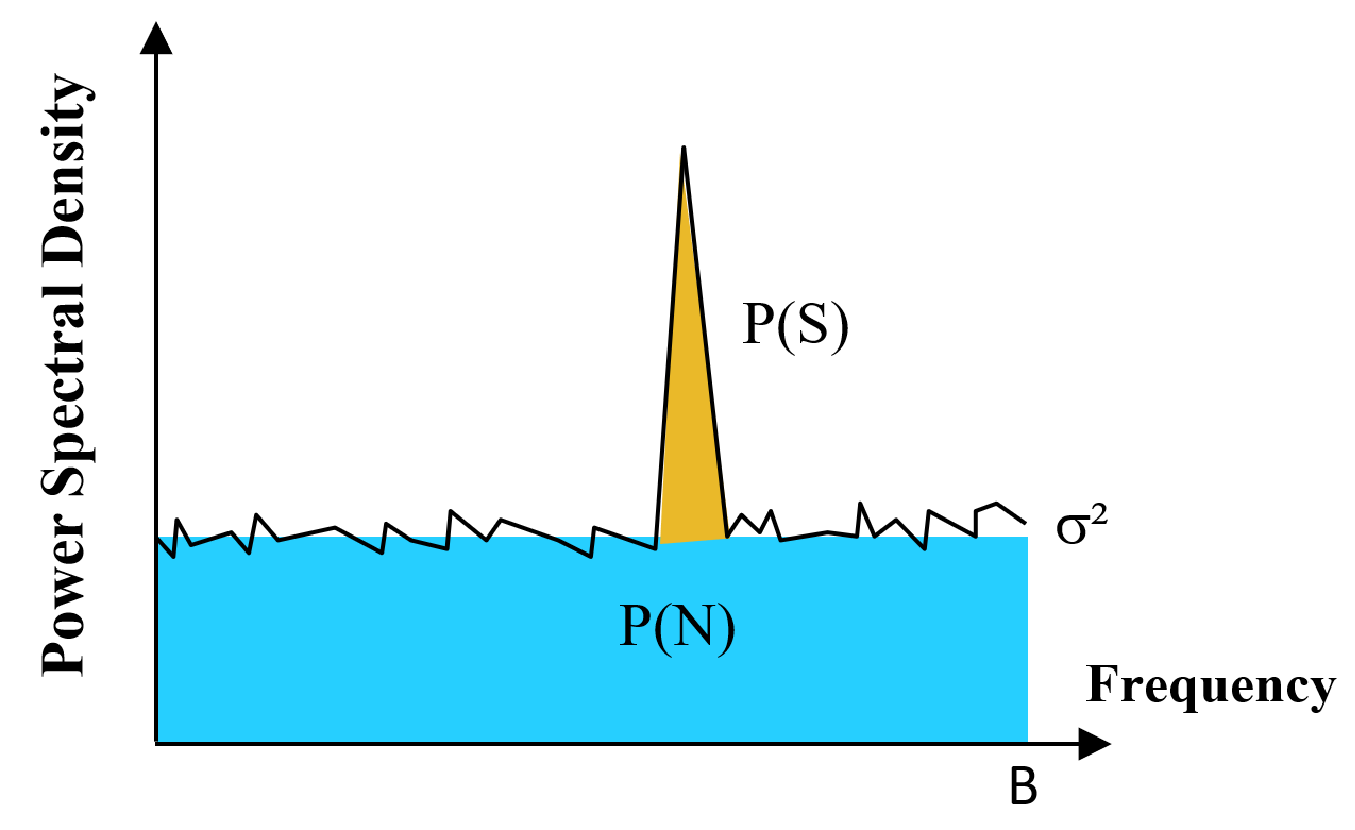
CNR stands for carrier-to-noise ratio. It represents the number of photons received from aerosol backscatter for a given range gate during the accumulation time. It can also be defined as the ratio between the cumulated power spectral density below the Doppler peak, P(S) (in orange in the graph below) and the cumulated power spectral density corresponding to the noise, P(N) (in blue). In IRIS Focus, CNR is directly obtained from the NetCDF files of the Windcube Scan Lidar.
SNR stands for the signal-to-noise ratio. It is a measure of post-processing signal quality and the quality of the wind velocity estimation.