
Calculating nowcasting predictions
In nowcasting, a precipitation field is considered a single pattern that can move and change with time. Placing the analyzed area on a grid, the first step in nowcasting is to compute a set of velocity vectors, one for each tile of a fixed size and then use them to predict future movement. Calculations are based on a cross-correlation of patterns.
In IRIS Focus, the motion vector fields (MVFs) calculated to support nowcasting cover the area measured by the radar. Zooming in and out of the display does not change the calculations.
Nowcasting process
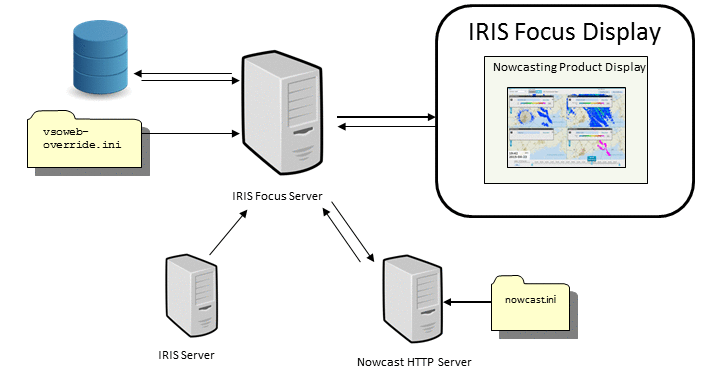
The following process explains how IRIS Focus creates nowcasts of its cartesian products in two steps: first create a motion vector field (MVF) and then use the MVF to advect products into the future.
-
Read the nowcasting configuration on start-up.
-
Run the radar data sequence.
-
Calculate the current velocity as a motion vector based on configurable settings.
MVF generation is done in the nowcast server, which by default is installed on the IRIS Focus server. The nowcast server takes requests from the web application and returns MVF products. Advected product generation is done in the web application.
MVF calculations use the last few products generated of a Cartesian product and passes them through the nowcasting algorithms. Note that since the last generated products are used, depending on the product schedule, it is possible that the first advected image is before the current time.
The MVFs are visible in IRIS Focus as a separate product and are used by IRIS Focus in nowcasting other radar products.
-
Run the nowcasting advection and velocity calculation algorithms to determine how the precipitation elements in the atmosphere will move in the near future.
See Calculating advected products and Calculating motion velocity.
-
Display nowcasting predictions in IRIS Focus.
See Animation timeline.